The Edwardians
The Edwardians

The Edwardians

1972-11-21 | en
Watch similar movies
Apple TV
Watch similar movies on Apple TV for free
Watch Free for 30 Days

Stream thousands of hit movies and TV shows

Start 30-day Free Trial

Seasons & Episodes

1
EP1  Mr Rolls and Mr Royce
Nov. 21,1972
Mr Rolls and Mr Royce

In the early 20th century, the motor car was not only new but was looked upon somewhat askance by almost everyone as something that was unreliable and had little future. Frederick Royce from Birmingham had a different view. His company manufactured electric dynamos but his passion became the gasoline powered motor car. Throughout 1903–1904, he designed, built and tested his first 2-cylinder car. Its quality in terms of reliability and smooth running was unknown at the time. Meanwhile, Charles Rolls resides in London and shares Royce's passion for the automobile. The son of a Baron, Rolls is an adventurer who liked to test the limits of cars and later airplanes. An avid racer and balloonist, he'd had little difficulty selling Royce's vehicles once the two finally met in 1904 and together formed Rolls-Royce Ltd in 1906. Their emphasis on quality automobiles remains their hallmark today.

EP2  Horatio Bottomley
Nov. 28,1972
Horatio Bottomley

Over several decades, Horatio Bottomley was a figure simply larger than life. Frequently sued for fraud or slander, he always defended himself in court and usually won. He was elected as a Member of Parliament and published the John Bull magazine from 1906, which he used to feed the need for the everyman to have someone tear down and attack society's institutions. Bombastic, arrogant and opinionated are only a few views of him as are eloquent, influential and revered.

EP3  E. Nesbit
Dec. 05,1972
E. Nesbit

Edith Bland was a very successful author and poet who wrote under the name 'E. Nesbit'. Many of her books were for children and several, such as The Railway Children, were turned into film. Edith married Hubert Bland and theirs was a different relationship as it included another woman, Alice Hoatson, who lived with them.

EP4  Conan Doyle
Dec. 12,1972
Conan Doyle

Sir Arthur Conan Doyle, creator of Sherlock Holmes, has his own mystery to solve when he answers a call from George Edalji, who claims to have been falsely convicted of mutilating animals and imprisoned. Edalji had been accused in a series of anonymous letters and Conan Doyle finds that the police seem to have reinterpreted evidence to fit the accused's movement. His spirited defense of Edalji in a newspaper article leads to friction with the powers that be, particularly in the police.

EP5  Baden-Powell
Dec. 19,1972
Baden-Powell

Robert Baden-Powell spent his life in the military and rose to the rank of Lieutenant General. A national hero for the defense of Mafeking in the Boer War and led the inhabitants through a seven month siege, holding on until relief arrived, Baden-Powell returns to learn that his book has become a bestseller. Following retirement, his last position was that of Inspector General, he concentrates on the group for which he is now best remembered, the Boy Scouts.

EP6  The Reluctant Juggler
Dec. 26,1972
The Reluctant Juggler

Tales of the Edwardian music hall and its entertainers

EP7  Daisy
Jan. 02,1973
Daisy

Daisy, mistress of Edward VII and a convert to Socialism looks back at her life as she dictates her memoirs to Frank Harris.

EP8  Lloyd George
Jan. 09,1973
Lloyd George

The paradox of a politician who was once a force for social change, a negotiator and untiring philanderer.

SEE MORE

The Edwardians Trailers

View All

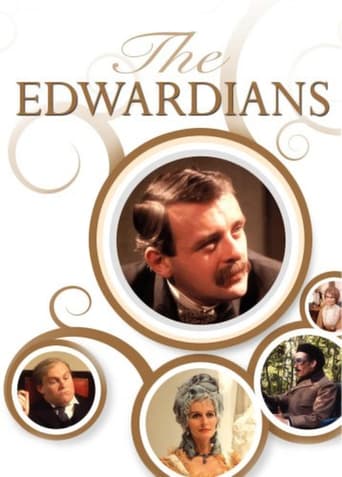
The Edwardians is an eight-part miniseries broadcast in 1972–73. An anthology, each 90-minute episode explores influential figure(s) of the Edwardian era: Charles Rolls and Henry Royce; Horatio Bottomley; E. Nesbit; Sir Arthur Conan Doyle; Robert Baden-Powell; Marie Lloyd; Daisy Greville, Countess of Warwick; and David Lloyd George.

The Edwardians Audience Reviews

Cubussoli Very very predictable, including the post credit scene !!!
NekoHomey Purely Joyful Movie!
Gary The movie's not perfect, but it sticks the landing of its message. It was engaging - thrilling at times - and I personally thought it was a great time.
Bob This is one of the best movies I’ve seen in a very long time. You have to go and see this on the big screen.
kidboots If you are expecting a retelling of the life of some eminent Edwardians you will not be disappointed. Colour would have been a real bonus - it was originally in colour but only 2 have retained it (they are two of the best) the rest are in a murky gray and white which is very unflattering especially if there is an out door or forest scene. Some of the episodes are - "MR. ROLLS AND MR. ROYCE" - was one of the best, it had rich colour and the exciting coming together of the Rolls Royce motor car. Another thing, especially in this episode, was how actors threw themselves into roles with gusto back then. No standing around whispering menacingly like they do now - in this series you certainly find out what "speaking with passion" means. None more so than Robert Powell as Rolls, a mercurial "rich kid" who is a fanatic about cars, planes and ballooning, joins forces with Royce (Michael Jayston) a dour workaholic from the North, how they bury their differences to make a luxury car and their efforts to see it is not turned into a cheap utility car like the Ford. There is a lot of technical knowledge in this episode including how Rolls (who had a need for speed) is warned of a "speed trap" - two policemen hiding in the bushes!! and the story of how someone was given a ticket because he failed to have his "man" running in front of the car with a red flag!! Jayston and Powell are both excellent but Powell may just have the edge as the more emotional (hysterical) Rolls."E. NESBITT" was a terrific episode with the very talented Judy Parfitt as Edith who remembers back over her life. She is married to a womanizer, Hubert Bland (played with a lot of sympathy by James Villiers) and realises that her good friend Alice is having his child. Originally a greeting card verse writer, she puts her love of children and the magic of make believe to good use as she begins to write "The Treasure Seekers" (on the flip side she has also written some of the most chilling and frightening ghost stories ever!!). I actually realized why I always loved her books as a child and as an adult - it is because she actually loved children herself, the house was always overflowing with children and they seemed to benefit from the parent's unusual "open" marriage."THE RELUCTANT JUGGLER" - in my opinion one of the best episodes. About the infiltration of unions into the London music halls. "The Great Alfredo" is being pressured to join the union but he is not a headliner and doesn't think the union will look after him if he is laid off. George Sewell (from "Special Branch") is the lead singer and organiser. Class systems were very much alive and well in this era - the upper class don't believe the poor are smart enough to organize themselves. Takes place over one night and the episode is interspersed with some of the leading entertainers of the era - Vesta Victoria, Gus Elen, Marie Lloyd (Georgia Brown is a standout), George Formby Snr. and Charlie Coburn ("The Man Who Broke the Bank at Monte Carlo")."BADEN POWELL" - Ron Moody was General Baden Powell at the end of his military career. He was feted as a hero of the Maefeking siege but in reality he was a sham and is racked with self doubt. He has already written his manual on scouting but after observing what he calls "weak kneed slackers who are too busy smoking to work" sets about organising the boy scouts. I got the impression that his initial thoughts were to train up boys to be good soldiers, to be willing to stand up for King and Country and to die for your mates - not really the innocent dib, dib, dib of memory. In fact it reminded me of a documentary I had seen on the beginnings of the Hitler Youth Movement - Scary stuff!!!"DAISY". Past mistress of Edward VII, Daisy (Virginia McKenna) is encouraged by racy journalist Frank Harris (who should have had his own episode) to write her memoirs. Filmed in a surrealist, pantomime setting on one stage complete with musical interludes this just didn't fit in with the style of the others and is one episode that would have been greatly enhanced by colour. She recounts her life as a promiscuous young bride whose exploits bring her to the attention of the Prince of Wales. She soon has the future king wound around her little finger so his advisors feel he would be better off with a new, discreeter "interest" - Alice Keppel."LLOYD GEORGE" - Anthony Hopkins is just tremendous as Lloyd George the flamboyant politician with feet of clay. The death of his beloved daughter Margaret (Joanna David occasionally to be seen in "Midsomer Murders" and "Inspector Morse") shows George beside himself with grief but who cannot abide to have anything to do with the realities of grief (the funeral etc). While grappling with a disillusioned son (who finds him in bed with a Countess) he is made Chancellor of the Exchequer. Through it all his loyal wife Margaret (Annette Crosbie) bears all but even she feels at the end of her rope when she is expected to go to court to show her support when her husband's affair is splashed all over the papers - he needs her desperately to help him get his landmark budget passed. Rich colour greatly enhances this particular episode.Stunning series - best episodes - "Mr. Rolls and Mr. Royce", "E. Nesbitt", "The Reluctant Juggler", "Baden Powell" and "Lloyd George". The other episodes are "Horatio Bottomley" and "Conan Doyle".
theowinthrop The series was only shown once in the U.S., and not in 1972, but more likely 1975 or so. It was shown on "Masterpiece Theatre" but not the entire eight episodes. Only a few of the episodes were shown, such as one about a strike that threatened the British Music Halls, that involved Marie Lloyd (Georgia Brown) and Charles Coborn (Peter Pratt, singing "The Man Who Broke The Bank At Monte Carlo" - Coborn's most famous number). The plot in that episode was how Lloyd was trying to talk an illusionist to join the budding labor walk-out. The episode regarding the founding of Rolls - Royce (with Michael Jayson as Henry Royce) was another of the episodes, as was one dealing with Sir Arthur Conan Doyle (Nigel Davenport) saving a young Parsee solicitor named George Edalji (Sam Dastor) from being accused of maiming and mutilating horses and cattle in England's midlands (the basis, by the way, of the play EQUUS). Anthony Hopkins played David Lloyd George, rising in this period to the Chancellorship of the Exchequer, and finding that his personal life and personality threaten his ambitions to be Prime Minister one day. The connecting link of the episodes was Thorley Walters, as Prince of Wales, and later King Edward VII. His own life was illustrated in dealing with his love affair with Alice Keppel. But that episode never aired in the U.S., nor did episodes about Baden-Powell and the founding of the Boy Scouts and the oddest of "great" Edwardians, the journalist - politician - lay lawyer, and swindler - Horatio Botttomley (Timothy West). Those episodes that were broadcast were pretty good (especially Hopkins, in real life a Welshman, playing one of history's greatest Welshman for a change). One wishes that the complete series was shown one day - it deserved to be shown completely.